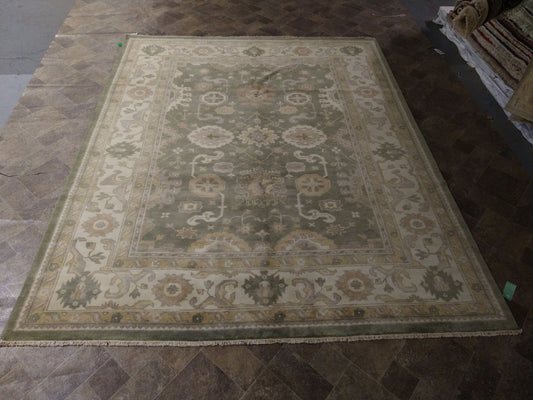
Chobi & Peshawar Rugs: The Vegetable-Dye Guide
Here's a quiet problem in the rug world: plenty of people love everything about hand-knotted rugs, the craft, the wool, the decades of life, except the saturated reds and navies the tradition is famous for. Their homes are linen, oak, sage and ivory, and a crimson Kashan would land like a marching band at a book club.
Chobi rugs exist to solve exactly that. Same ancient construction, completely different volume.
What "Chobi" Means
The name comes from chob, the Persian and Urdu word for wood, and it describes the palette: woody, earthy, natural. These rugs are woven mostly in and around Peshawar in northern Pakistan, and across the border in Afghanistan, which is why the trade uses "Chobi," "Peshawar," and sometimes "Ziegler" almost interchangeably for the same family of rugs.
That last name carries the origin story. In the late 1800s, the Anglo-Swiss firm Ziegler & Co. commissioned Persian workshops around Sultanabad to weave rugs tailored to Western homes: bigger, more open patterns and softer colors than the dense classical style. Those Ziegler carpets became wildly loved. The modern Chobi is that idea reborn, largely by Afghan master weavers, many working as refugees around Peshawar from the 1980s onward, using the old methods: hand-spun wool, natural dyes, classic designs redrawn with room to breathe.
The Two Things That Define Them
Vegetable dyes. Chobi colors come from plants and minerals, madder root for soft rusts and salmons, pomegranate rind and weld for golds, indigo for the blue-grays, walnut husks for browns. Natural dyes age differently than synthetics: instead of dulling, they mellow, developing the gentle, sun-washed depth that makes a ten-year-old Chobi look better than a new synthetic-dyed rug. The palette is the point: faded gold, sage, ivory, oatmeal, muted rust, colors that behave like neutrals with a history.
Hand-spun wool. The yarn is spun by hand, which leaves slight thick-and-thin variation along every strand. That unevenness is a feature: it takes dye irregularly, catches light irregularly, and gives the surface a lively, softly antique texture no machine-spun yarn can fake. Combined with the finishing wash most Chobis receive, the result is a new rug that reads as a gracefully aged one.

The Designs: Classics, Decluttered
Chobi patterns borrow from the greatest hits, Oushak medallions, Sultanabad florals, Heriz geometry, Khotan motifs, but redrawn with generous spacing and low contrast, so the pattern whispers where the originals declaim. From across a room, a Chobi reads as texture and warmth rather than ornament, which is precisely why designers reach for them in transitional, farmhouse and modern-organic interiors. It's the hand-knotted rug that doesn't ask the room to become traditional.
If your home runs neutral and you've been assuming real Persian-style rugs weren't for you, this is the aisle you were looking for.
Buying One: What to Check
The standard [five authenticity checks](INTERNAL LINK: /blogs/rug-guides/how-to-tell-if-persian-rug-is-authentic) apply, back, fringe, pile, dye, price. Chobi-specific notes: abrash is expected and abundant here, hand-dyed batches guarantee it, and it's half the charm. The damp-cloth dye test matters since natural dyes vary in fixing quality; a good Chobi won't bleed. Feel for the hand-spun wool's slight irregularity and a dense, meaty handle. And know the vocabulary trap: "Chobi-style" or "washed look" on a cheap rug usually means a machine-made print of this aesthetic, the back never lies.
Prices sit in the accessible middle of hand-knotted, above village Hamadans, below fine Tabriz, and the cost-per-year math works the same as ever. Size before style, as always: numbers in the size guide.

Caring for Vegetable Dyes
Nothing exotic: vacuum without the beater bar, rotate twice a year, blot spills fast with cool water only, no harsh spot chemicals, which can disturb natural dyes where synthetics would shrug. Moderate the direct sun on the palest pieces. Full routine in the cleaning guide.
FAQ
What is a Chobi rug?
A hand-knotted rug woven around Peshawar, Pakistan and in Afghanistan using hand-spun wool and natural vegetable dyes, in soft, earthy palettes inspired by antique Ziegler and Oushak carpets.
Are Chobi and Peshawar rugs the same thing?
Effectively yes, the trade uses Chobi, Peshawar and often Ziegler for the same family of vegetable-dyed, hand-spun-wool rugs from that region.
Do vegetable-dyed rugs fade?
They mellow rather than fade: natural dyes soften gracefully with age and light, which is considered part of their beauty. Avoid constant harsh direct sun on the palest colors.
Are Chobi rugs good quality?
Good ones are excellent: dense hand-knotted construction, premium hand-spun wool, and finishing that improves with age. Judge each rug by its back, wool and dye behavior.
Bottom Line
A Chobi is the full hand-knotted inheritance, wool, knots, decades, delivered in colors a modern neutral home can actually live with. Browse our Chobi & Peshawar collection, hand-knotted and certified.