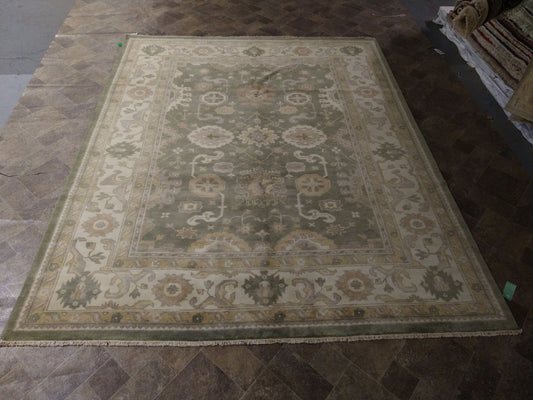
How to Tell if a Persian Rug Is Authentic: 5 Checks
The uncomfortable truth about rug shopping: a machine-made copy of a Persian rug and a real hand-knotted one can look nearly identical from standing height. The difference is a few hundred dollars versus a few thousand, and a 10-year rug versus a 100-year one. Sellers know most buyers can't tell.
You can tell. It takes five checks and about three minutes, no expertise required.
Check 1: Flip It Over
This settles most cases on its own. On an authentic hand-knotted rug, the back is a mirror of the front, the pattern shows clearly in the knots, just slightly muted. You're looking at the actual construction, thousands of individually tied knots, and up close they'll be slightly uneven, some rows a hair tighter than others.
A machine-made rug shows a uniform, grid-perfect back, often with a stiff mesh or plastic-feeling layer. A hand-tufted rug (the common middle deceiver) hides behind a glued-on canvas backing, if the back is covered in plain fabric, glue is holding that rug together, and it shouldn't be priced like hand-knotted.
Check 2: Pull at the Fringe
On a real Persian rug, the fringe isn't decoration. Those tassels are the ends of the warp threads, the structural skeleton the whole rug is knotted onto. They flow out of the rug's body.
On machine-made rugs, fringe is sewn or glued on afterward to fake the look. Look where fringe meets rug: a visible stitched seam means it was attached, which means machine.

Check 3: Part the Pile
Spread the pile apart with your fingers and look at the base. Hand-knotted: you'll see the individual knot loops wrapped around the warp threads, in slightly irregular rows. Machine-made: perfectly uniform rows, and often you can see the fibers are held by the backing rather than tied. While you're in there, feel the material, real Persian rugs are wool (sometimes silk), which feels dry and springy. A waxy or plasticky slickness means synthetic fiber, and no authentic Persian rug is synthetic.
Check 4: Test the Dyes and Look for Abrash
Rub a damp white cloth firmly on a small area. Quality dyes shouldn't bleed onto the cloth; heavy color transfer is a red flag for cheap dyes and often a cheap rug overall.
Then look across the field of the rug in good light for abrash, subtle horizontal bands where the color shifts slightly. It happens when the weaver starts a new batch of hand-dyed yarn, and it's one of the most reliable authenticity tells because machines don't do it. Dealers don't hide abrash, they point at it.
Check 5: Apply Price Logic
A hand-knotted 8x10 takes a weaver months to over a year. That labor has a floor. If someone offers you a "genuine hand-knotted Persian" 8x10 for $299, one of you is confused, and it isn't them. Real hand-knotted 8x10s start around $1,000 to $1,500 even at honest discount pricing, and climb with knot density, origin and age.
Watch the vocabulary too. "Persian-style," "Persian-inspired," and "Oriental design" all legally mean machine-made in a Persian pattern. And "handmade" often means hand-tufted, glue gun, not loom. If a listing won't say the words hand-knotted, wool, and a specific origin, assume the omission is deliberate.

What About Certificates and Documentation?
A certificate of authenticity stating origin, materials, knot density and construction is standard practice for reputable dealers, we include one with every rug, and its absence at a high price point is worth questioning. But treat paper as a supplement, not a substitute: certificates confirm what the rug's own back, fringe and pile should already be telling you. The rug is the document.
One more legitimate wrinkle: plenty of excellent hand-knotted rugs come from Pakistan, Afghanistan, India and the Caucasus rather than Iran. Those aren't fakes, they're authentic hand-knotted Oriental rugs, just not Persian, and honest sellers label them exactly that way. Our rug styles guide covers who weaves what.
FAQ
How can I tell if a Persian rug is real?
Flip it over. If the pattern is clearly visible in slightly irregular knots on the back, and the fringe grows out of the rug rather than being sewn on, it's hand-knotted. Uniform grid backing or attached fringe means machine-made.
Are Persian rugs from Pakistan fake?
They're not Persian (Persian means woven in Iran), but they're often authentic hand-knotted rugs of real quality. The problem is only mislabeling, a Pakistani Bokhara sold as a Pakistani Bokhara is a legitimate rug.
How much should a real Persian rug cost?
Hand-knotted 8x10s realistically start around $1,000 to $1,500 and rise with knot count, materials and age. Far below that, you're almost certainly looking at machine-made or hand-tufted.
Is abrash a defect?
No, the opposite. Those subtle color-band shifts come from hand-dyed yarn batches and are a hallmark of authentic handwork. Machine-made rugs are too consistent to have it.
Bottom Line
Back, fringe, pile, dye, price. Five checks, three minutes, and no one can sell you a $300 rug for $3,000 again. Every rug we sell passes all five in your hands, browse the collection and flip any rug you like.