What Is a Heriz Rug? History, Serapi & Buying Guide
Ask any old rug dealer which Persian rug they'd put in a house with kids, dogs, and a hundred years of foot traffic ahead of it, and you'll get one word: Heriz. These are the rugs you find in estate sales looking better at age 90 than most rugs look at 10. There's a reason American living rooms adopted them over a century ago and never let go.
Here's what makes a Heriz a Heriz, what "Serapi" actually means, and what to check before buying one.
Where They Come From
Heriz is a town in the mountains of northwest Iran, near Tabriz, surrounded by a cluster of weaving villages. And here's the odd geological footnote that explains everything: the region sits on copper deposits, and traces of copper in the drinking water of the sheep make the local wool unusually strong and resilient. That's not marketing folklore, it's the accepted explanation in the trade for why Heriz wool wears like iron while staying lustrous.
The weaving itself is village work, done from memory and instinct rather than precise city cartoons, which is where the style's charm comes from. Nothing in a Heriz is perfectly straight, and nothing is supposed to be.
How to Recognize One in Two Seconds
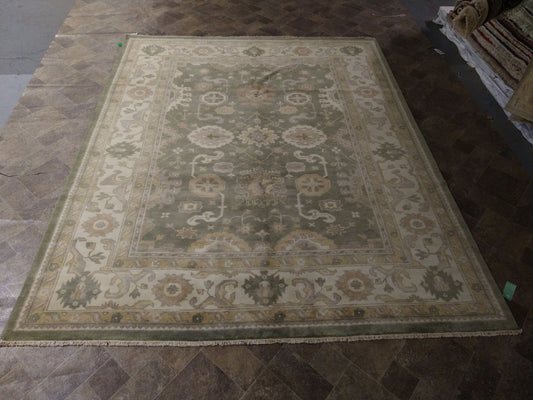
One giant angular medallion in the center, drawn entirely in straight lines and sharp corners, no curves. Large cornered pieces in ivory anchoring the four corners of the field. Oversized, almost abstract leaves and vines filling the rest. And that palette: brick red or rust ground, navy medallion, ivory corners, with touches of salmon, camel and green.
If a Kashan is calligraphy, a Heriz is a woodcut. Bold, graphic, confident. It's why designers keep putting them in modern interiors, the geometry reads almost contemporary despite being a 19th-century village tradition.

Heriz vs Serapi: The Name That Confuses Everyone
Walk into a rug shop and you'll see "Serapi" priced above "Heriz" and wonder what the difference is. Here's the honest answer: Serapi isn't a place or a separate weaving tradition. It's an American trade name, likely from the nearby village of Serab, that dealers use for the older, finer grade of Heriz weaving, generally pieces from the late 1800s to early 1900s with softer, more spacious designs and lighter, more varied color.
So every Serapi is a Heriz, but dealers reserve the word for the antique good stuff. If someone offers you a brand-new "Serapi," they mean a new rug woven in that older, airier Heriz style, fine, just know the word is describing a look, not a pedigree.
Why They Last So Long
Three reasons stack up. The copper-fed wool, as mentioned. The construction, Heriz rugs are woven on a sturdy double-wefted cotton foundation with a coarser knot than city rugs, and coarser here means durable, not sloppy, there's simply more wool per knot absorbing the abuse. And the pattern itself: all that bold geometry and color variation hides wear, dirt, and the occasional sin of a spilled glass better than any pale minimalist rug ever will.
This is why Heriz rugs are the standard recommendation for actual living rooms, the kind with traffic, rather than rooms people look at from the doorway.
Buying One: What to Check
Flip it and look for the hand-knotted tells, pattern visible in the back, fringe growing from the warp, slight irregularities row to row (our [authenticity guide](INTERNAL LINK: /blogs/rug-guides/how-to-tell-if-persian-rug-is-authentic) walks through all five checks). On a Heriz specifically, expect and even want some crookedness: slightly wavy borders and an off-center medallion are village authenticity, not defects. Perfectly symmetrical "Heriz design" usually means machine-made in the Heriz pattern.
Color should glow, not shout. Vegetable-dye-style brick reds and soft navies age beautifully; harsh scarlet can signal cheap synthetic dyes. And abrash, those horizontal shifts in tone, is a good sign here, as always.
Size-wise, Heriz rugs mostly come in room sizes, 8x10, 9x12 and up, because that's what the American market has demanded from them for a century. Check your measurements against the rug size guide first.

Styling a Heriz
The classic pairing is leather and wood, a Heriz under a chesterfield is practically an American institution. But the modern move is contrast: put one under a clean-lined linen sofa or in a white-walled minimalist room and the geometry suddenly looks like graphic art. The rust-and-navy palette plays well with camel, cream, olive and brass. About the only thing a Heriz fights is another loud pattern at the same scale, let it be the loudest thing in the room.
FAQ
What is the difference between Heriz and Serapi rugs?
Serapi is the trade name for older, finer Heriz weavings, typically antique pieces with softer colors and more open designs. Same region, same tradition, higher grade.
Are Heriz rugs a good investment?
They hold value better than most Persian rugs because demand never fades, especially for antiques and Serapis in good condition. Buy one to live on, and it'll likely still be worth real money decades later.
Why are Heriz rugs so durable?
Unusually resilient regional wool (credited to copper traces in the local water), sturdy double-wefted construction, and a forgiving high-contrast pattern that hides wear.
Do Heriz rugs work in modern homes?
Yes, arguably better than any other traditional Persian style. The straight-line geometry reads almost contemporary against minimalist furniture.
Bottom Line
A Heriz is the Persian rug you buy to use, not to protect. Bold, nearly indestructible, and at home under both a leather chesterfield and a modern linen sofa. See what's in our Heriz & Serapi collection, every piece hand-knotted and certified.