Aubusson Rugs: French Elegance, Explained
Nearly every rug in this shop traces back to a loom in Iran, Turkey, the Caucasus or Central Asia. The Aubusson is the exception, and it's a spectacular one. This is Europe's answer to the Oriental carpet: a rug born not among nomads and village weavers but in the workshops of the French crown, drawn by artists, woven for Versailles, and built around a completely different idea of what a floor should look like.
If the Persian tradition speaks in dense, saturated ornament, the Aubusson speaks in pale light and open space. Pastel fields. Rose garlands. Architectural scrollwork. Rooms breathe around it.
Here's where it came from, why the construction confuses everybody, and how to buy one.
The Town on the Creuse
Aubusson is a small town in central France, on the banks of the Creuse River, about two hundred miles from Paris. Weaving began there in earnest in the sixteenth century, possibly seeded by Flemish refugees centuries earlier, and the town's isolation and soft river water, ideal for dyeing, let a highly specialised craft community develop undisturbed.
Crucially, Aubusson began as a tapestry town, not a carpet town. Its weavers made pictorial wall hangings. When French aristocrats grew tired of paying enormous sums for imported Oriental carpets, Aubusson's weavers simply turned their tapestry technique to the floor.
Two dates matter. In 1627, the crown established the Savonnerie manufactory in Paris, in a former soap factory (savon means soap), to weave pile carpets using the Turkish knot, French rugs meant to out-luxury anything from the East. Then in 1665, Aubusson received the title of Manufacture Royale, and its lighter, cheaper, faster flatwoven carpets began furnishing the châteaux and hôtels particuliers of the aristocracy.
That's the split that still defines the category: Savonnerie is the plush court carpet. Aubusson is the elegant flatweave. Same design language, different construction, different price, then and now.
How an Aubusson Was Made
This is the part that makes people fall in love with them.
An artist first painted a cartoon, a full-scale design on canvas, and here's the strange bit: drawn in reverse. The weaver, called a lissier, worked at a horizontal loom from the back of the rug, following the mirrored cartoon and never seeing the finished face until the piece came off the loom. The yarns were dyed in-house, which is why antique Aubusson palettes have that specific, nuanced, unrepeatable softness.
The technique itself is weft-faced tapestry weaving: coloured weft threads packed tightly through the warp until they hide it entirely, and the pattern is the cloth. Structurally, this is the same family as the the flatweave tradition of the East, which is a lovely irony, France's most aristocratic floor covering shares its construction with a nomad's tent rug. What differs is everything else: the drawing, the palette, the ambition.
And because flatweaving is far quicker than knotting, Aubussons could be made enormous and custom, which is exactly why the aristocracy ordered so many. Room-size, oversized, oval, square, whatever the salon required.

How to Recognise an Aubusson
The vocabulary is unmistakable once you know it, and it's the vocabulary of French decorative art rather than of rug-making.
A central medallion, often oval or lozenge-shaped, drawn like an architectural ornament rather than a Persian flower. Floral garlands and wreaths, roses, violets, small blossoms, rendered naturalistically, as though painted. Scrolling acanthus leaves, ribbons, cartouches and urns. Guilloche and palmette borders on the Neoclassical pieces. And around all of it, open field, generous, uncrowded space. An Aubusson does not fill every inch. That restraint is the whole point.
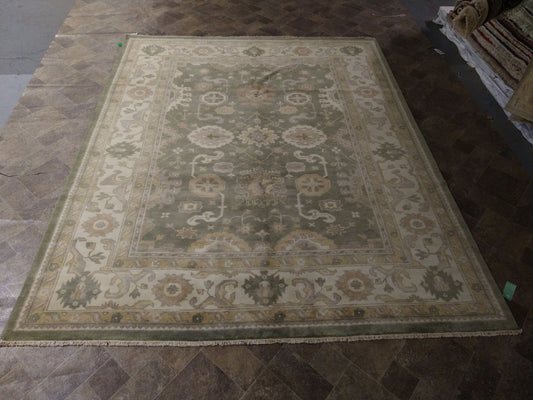
The palette is the other giveaway: soft, pale, architectural. Ivory, cream, faded rose, sage green, pale gold, dove blue, periwinkle. Where a Kashan and its deep red field saturates, an Aubusson washes. Antique examples have often mellowed into something close to watercolour.
The styles track French history exactly: Baroque grandeur under Louis XIV, Rococo curves and pastel asymmetry under Louis XV, then Neoclassical order, geometry and Greco-Roman restraint under Louis XVI. That last vocabulary never went away, it's the ancestor of most "transitional" rug design being made today.
Flatwoven or Hand-Knotted? The Confusion, Cleared Up
This trips up almost every buyer, so let's be precise.
Historic Aubusson carpets are flatwoven tapestries. No pile. That's the tradition, and it's what a serious antique dealer means by the word.
But "Aubusson" today also describes a design language, and that design is widely woven as a hand-knotted pile rug, usually in wool, often with a low, carved pile that gives the florals depth.
These are not fakes and they're not imitations of a lesser thing, they're a legitimate modern branch, and for most homes they're the more practical choice: a pile Aubusson is warmer, softer underfoot, more forgiving, and considerably more durable than a two-hundred-year-old tapestry.
So the honest framing is this:
- Want the antique object, the museum piece, the historical artefact? You want a flatwoven French Aubusson, and you should expect antique prices and antique fragility.
- Want the Aubusson look in a room people actually live in? A hand-knotted pile Aubusson gives you the same French vocabulary with the construction of a proper hand-knotted rug.
Both are honest. What isn't honest is a seller blurring the two. Ask directly: is this flatwoven or pile, and where was it made? Anyone who won't answer plainly has told you something.

Buying One: What to Check
Beyond the usual authenticity checks for any hand-knotted rug, Aubussons have their own criteria, and they're more about design than technique.
Is the drawing crisp? The whole appeal rests on delicacy. Muddy, blurred florals mean the weaver was reaching beyond the weave's resolution, and on a design this fine, that shows immediately. This is one case where knot count genuinely matters, you cannot draw a rose garland at 80 KPSI.
Is the border balanced against the room? Aubussons have heavy, elaborate borders. In a small room, a broad border eats the field and the rug looks like a picture frame with nothing in it. Scale matters more here than with almost any other style.
Does the medallion suit your furniture plan? A big central medallion wants to be seen. Bury it under a coffee table and you've paid for something nobody will ever look at.
Does the palette serve the architecture? Aubussons are made to support panelled walls, plaster, art and antique furniture, not to compete with them. Choose the field colour against the room's permanent features, not against a trend.
Condition, on antiques. Flatweaves have no pile to hide wear, so ends, edges and any restoration are exactly where to look. Structure should be stable even where the surface has mellowed.

Where an Aubusson Belongs
Obviously: formal salons, dining rooms, libraries, panelled reception rooms. Anywhere with French antiques, plaster, mouldings or classical furniture, the rug was designed for exactly that architecture and it slots in like a missing piece.
Less obviously, and more interestingly: modern interiors. This is where Aubussons are quietly having a moment, and the reason is simple. A pale, open-field Aubusson brings formality without heaviness.
It gives a contemporary room history, softness and structure without the visual density of a Persian carpet. Put one under a clean-lined sofa in a white room and it reads as calm and architectural rather than ornate. Designers use them precisely as a counterpoint, the one antique thing in an otherwise spare space.
They also hang beautifully, the tapestry heritage means the flat versions were half wall-art to begin with.
One practical note: because the palette is pale, an Aubusson is not the rug for a household with muddy paws and red wine. That's not snobbery, it's just physics. If your rooms are busy, our pet-friendly rug guide points you somewhere more forgiving, and you can come back to the Aubusson for the formal room.
Caring for One
Gentle, on both versions. Vacuum with suction only, no beater bar, especially on flatwoven pieces where a rotating brush will catch and pull the weave. Use a rug pad. Rotate twice a year. Blot spills immediately with cool water and never scrub, pale wool is unforgiving.
Keep it out of prolonged direct sun, faded is charming, bleached is not, and the antique dyes are what you paid for. Full routine in our rug cleaning guide.
FAQ
What is an Aubusson rug?
A French carpet in the decorative tradition of Aubusson, a weaving town in central France. Historically flatwoven using a tapestry technique, Aubussons are known for pastel palettes, floral garlands, central medallions and architectural scrollwork.
Are Aubusson rugs flatwoven or hand-knotted?
Historic Aubussons are flatwoven tapestries with no pile. Today the Aubusson design is also woven as a hand-knotted pile rug, which is softer, warmer and more durable, and generally the better choice for a room in daily use.
What is the difference between Aubusson and Savonnerie?
Both are French court traditions with a shared design vocabulary. Savonnerie carpets are pile-woven with the Turkish knot, plush and grand. Aubusson carpets are flatwoven tapestries, lighter, quicker to produce and less expensive, historically the aristocratic rather than royal choice.
Do Aubusson rugs work in modern interiors?
Very well. Their pale, open fields bring formality without heaviness, which makes them a favourite counterpoint in contemporary rooms, they add history and softness without the visual density of a Persian carpet.
Are Aubusson rugs valuable?
Antique French flatwoven examples can be highly valuable, judged on period, condition, drawing and palette. Modern hand-knotted Aubusson-design rugs are far more accessible while offering the same aesthetic and better everyday durability.
Bottom Line
The Aubusson is the rug for people who want ornament and restraint at the same time, French, pale, architectural, and remarkably easy to live with in a modern room precisely because it refuses to fill every inch.
Browse our Aubusson collection, or compare it against the wider tradition in our guide to Persian and Oriental rug styles.