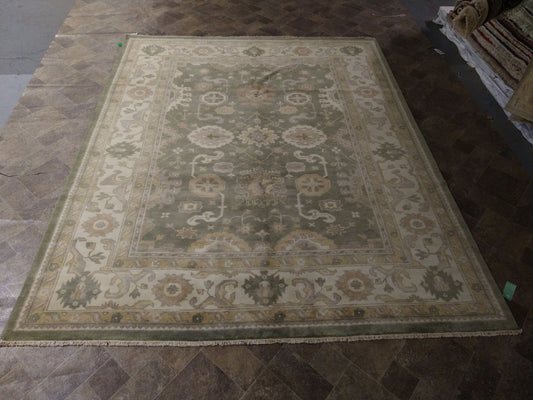
Persian Rug Price Guide: What Actually Determines Value
A Persian rug's price is set by six things: materials, workmanship, condition, age, provenance, and size. Not by the sticker, not by the discount, and not by any single number like knot count. Two rugs that look identical across a room can differ in value by a factor of ten because of what's underneath, how well it was made, and what can be proven about it.
Here's the number that cuts through everything else: divide the asking price by the rug's area in square feet. Genuine hand-knotted Persian work below roughly $50 per square foot almost always means something is wrong, machine-made, hand-tufted, mislabelled, or damaged. A real 9×12 (108 sq ft) Persian rug at $1,200 works out to about $11 per square foot. That rug does not exist. The labour alone costs more.
This guide explains why, so you can look at any price tag and know whether it makes sense.
Factor What raises value Materials Hand-spun wool, silk, natural dyes Workmanship Fine, even knotting; confident, balanced drawing Condition Full pile, stable foundation, no damage or overpainting Age Antique (80–100+ years), if condition holds Provenance Known origin, workshop, master signature, documentation Size & rarity Larger sizes, rare designs, unusual shapes
Factor 1: Materials
Materials set the ceiling on everything else. You cannot draw fine detail on coarse wool, and you cannot fake the way good fibre ages.
Wool is not just wool. The best Persian rugs use hand-spun wool, spun by hand rather than machine, which leaves a slight thick-and-thin irregularity along each strand. That unevenness takes dye with more depth and catches light with a subtle life that machine-spun yarn can't match.
High-lanolin wool from good flocks also wears with dignity, developing a soft sheen rather than going dull. Cheap, dry, over-processed wool feels dead in the hand no matter how many knots are in it.
Silk raises the price sharply, both as a full pile and as highlights that outline a design and catch the light. But silk alone doesn't settle value, a mediocre silk rug is still mediocre. What matters is how the material is used. We compared the two fibres in full in our wool vs silk guide.
Natural dyes are the other material signal. Madder root for reds, indigo for blues, pomegranate rind and weld for yellows, they age by mellowing rather than fading, and they produce the subtle colour variation (abrash) that collectors prize. Harsh, flat, uniform colour usually means synthetic dye and a lower-value rug.

Factor 2: Workmanship
This is the human element, and it's the single biggest driver of price. A fine 9×12 Persian rug can take a master weaver one to three years to complete. That labour, at master-craftsman skill, is what you're paying for.
Workmanship shows up in three places:
- Knot density, but read this carefully. Higher KPSI supports finer detail, and finer detail reflects more time and skill, so density correlates with value. But it is not value itself. As we explain in what knot count actually measures, a dense rug with clumsy drawing is worth less than a well-drawn rug at a lower count. A famous appraiser's example: a high-knot Nain is not automatically worth more than a lower-knot Heriz of real artistic merit.
- The drawing. Are the curves smooth, the motifs crisp, the borders balanced, the composition confident? This is where real skill lives, and you can see it without counting anything.
- Evenness. Consistent knotting, straight sides, a rug that lies flat. Wobbles and bulges signal rushed or unskilled work.
Factor 3: Condition
Condition often matters as much as age, and sometimes more. A pristine 50-year-old rug can be worth more than a worn, repaired 100-year-old one. This surprises people who assume age alone drives value. It doesn't.
What to check, and what hurts value:
- Pile. Full, even pile is ideal. Low, worn, or bald patches reduce value significantly.
- Foundation. The structure must be sound. Dry rot in the foundation is one of the most serious faults there is.
- Damage. Moth bites, holes, stains, uneven fading, and water damage all lower price.
- Overpainting. Old rugs are sometimes painted to hide worn areas, a serious red flag that a careful buyer looks for by parting the pile to inspect it.

Factor 4: Age
Age raises value, but only when condition holds. The rough tiers:
- New / modern: current production. Prices reflect today's rising material and labour costs, so a new rug isn't automatically cheap.
- Semi-antique (roughly 30–80 years): often the value sweet spot. Rising collector interest, mellowed dyes, but not yet antique-rare. Sometimes priced below new rugs, because older material and labour cost less than today's.
- Antique (80–100+ years): rarity, patina and history command premiums. All else equal, a 200-year-old rug outvalues a 100-year-old one, because it can never be made again.
One historical footnote that affects age dating in the US market: the United States banned Iranian rug imports from 1987 to 2000. That embargo shapes what's available and how certain vintages are valued, and it's part of why provenance paperwork matters so much.
Factor 5: Provenance
Here's the factor most buyers underestimate, and it can move price more than almost anything else.
Origin. Persian rugs are named for where they're woven, and the prestige weaving centres, Tabriz, Isfahan, Kashan, Qom, Nain, carry brand recognition that raises price the way a maker's name does anywhere. Tabriz alone commands a premium partly on demand and recognition.
Workshop and master signature. A rug from a known workshop, or signed by a master weaver, can be worth two to four times an identical-looking piece without that attribution. Documentation is, as one veteran dealer puts it, the cheapest insurance a buyer ever buys.
The Persian premium itself. Genuine Persian rugs typically command a 30–100% premium over comparable Turkish, Indian or Pakistani hand-knotted rugs of similar size and quality. That premium is real, but it depends entirely on the "Persian" claim being true, which is exactly where the market gets dangerous.

Factor 6: Size and Rarity
Size scales price straightforwardly, bigger rugs need more knots, more wool and more months, so they cost more. But it isn't purely linear: unusual shapes (ovals, rounds) can be worth more because they're harder to weave, while oversized pieces can be harder to sell simply because fewer rooms fit them.
Rarity works on design. Uncommon patterns, one-of-a-kind compositions, pictorial and hunting designs, and rare colour combinations all raise value, because demand favours the unrepeatable. A common medallion in common colours sits at the bottom of its bracket; the same quality of weaving in a rare design sits well above it.
The Price-Per-Square-Foot Reality Check
Now the practical tool that ties it all together, and the one every honest dealer quietly uses.
Divide the asking price by the area. Genuine hand-knotted Persian rugs generally range from about $50 to $200+ per square foot at retail, depending on the six factors above. Below $50/sq ft for something sold as hand-knotted Persian, treat the listing as guilty until proven innocent.
| Rug size | Area | $50/sq ft | $100/sq ft | $200/sq ft |
|---|---|---|---|---|
| 4×6 | 24 sq ft | $1,200 | $2,400 | $4,800 |
| 6×9 | 54 sq ft | $2,700 | $5,400 | $10,800 |
| 8×10 | 80 sq ft | $4,000 | $8,000 | $16,000 |
| 9×12 | 108 sq ft | $5,400 | $10,800 | $21,600 |
This is why the industry truth holds: the cheapest "Persian" rug in the room is usually not Persian. A sub-$1,500 rug marketed as a room-size Persian is almost always machine-made or hand-tufted, because the human labour inside a real one cannot be produced at that price. The number doesn't lie even when the label does.

Why the Same Rug Sells for $1,200 and $25,000
Persian rugs are one of the few markets where the identical physical object can sell for wildly different prices, both legitimately. The difference isn't always the rug. It's provenance, authentication, and the relationship behind the sale.
A documented rug from a trusted dealer costs more than an "unbelievable deal" from an unverified seller, and it's usually the better buy, because a well-chosen Persian rug from a reputable source is one of the best long-term home investments available, while a discount rug from a stranger is one of the most expensive mistakes a buyer can make. The paperwork, the return policy, and the dealer's reputation are part of what you're paying for, and they're the cheapest part.
This is also why the most expensive rug isn't always the best value. A $25,000 signed Tabriz can be a better hold than a $50,000 Isfahan of average craftsmanship. Price reflects materials and labour; value reflects materials, labour, condition, rarity and demand together.
Do Persian Rugs Hold Their Value?
Broadly, yes, better than almost any other floor covering, and better than most furniture. Well-made, well-documented Persian rugs from established regions typically retain or grow in value over decades, especially antiques in good condition and master-workshop pieces. Mass-produced lookalikes, by contrast, lose value the moment they leave the shop, exactly like a machine-made rug or a flat-pack table.
It's worth being sober about the word "investment," though. Most rugs aren't bought and sold for profit, and you shouldn't buy one expecting to flip it. Think of a fine Persian rug the way you'd think of solid antique furniture: it holds value, it can be passed down, and per year of use it often costs less than replacing cheaper rugs repeatedly. We ran that full cost-per-year comparison here.

How to Avoid Overpaying (and Underpaying)
Underpaying is a trap too, a suspiciously cheap "Persian" rug is cheap because it isn't one. Here's the buyer's routine:
- Run the square-foot maths before anything else. It's your fastest lie-detector.
- Compare at least three sources for similar size, origin and knot density.
- Ask the dealer to justify any premium in the price. A real one explains it, materials, workshop, age, rarity, without getting defensive.
- Demand documentation on anything expensive: origin, materials, age, and a certificate of authenticity. Paperwork can be worth 2–4× on its own.
- Verify it's hand-knotted with the five authenticity checks before money changes hands.
- Buy direct where you can. Every middleman takes a cut. Sourcing direct from the weaving region skips those layers, which is how honest hand-knotted rugs reach fair prices.
- Evaluate condition first on antiques. A dated origin means nothing if the foundation is rotting.

FAQs
What determines the value of a Persian rug?
Six factors: materials (hand-spun wool, silk, natural dyes), workmanship (fine, even, well-drawn knotting), condition, age, provenance (origin, workshop, documentation), and size or rarity. No single factor decides value, they're weighed together.
How much does a real Persian rug cost?
Genuine hand-knotted Persian rugs generally run about $50 to $200+ per square foot. A room-size 9×12 therefore starts around $5,000 and rises with quality, age and provenance. Anything sold as Persian below roughly $50 per square foot is almost certainly not genuinely hand-knotted Persian.
Does a higher knot count mean a more valuable rug?
Not by itself. Higher knot density allows finer detail, which reflects more skill and time, so it correlates with value. But a densely knotted rug with poor drawing is worth less than a well-executed rug at a lower count. Judge the whole rug, not the number.
Are older Persian rugs always worth more?
No. Age raises value only when condition holds. A pristine 50-year-old rug can outvalue a worn, repaired 100-year-old one. On antiques, always evaluate condition before age.
Why are Persian rugs more expensive than Turkish or Indian rugs?
Genuine Persian rugs typically command a 30–100% premium over comparable Turkish, Indian or Pakistani hand-knotted pieces, driven by weaving reputation, documented provenance and collector demand, provided the Persian origin is genuine and verifiable.
Do Persian rugs hold their value?
Well-made, documented Persian rugs from established regions typically retain or appreciate over decades, especially antiques in good condition. Mass-produced imitations lose value immediately. Treat a fine rug as a durable heirloom rather than a short-term investment.
How can I estimate my Persian rug's value?
Weigh the six factors together, then sanity-check with price per square foot. For anything significant, get a formal appraisal from a credentialed appraiser, this guide is a framework, not a substitute for professional valuation.
Summary
A Persian rug's price comes down to materials, workmanship, condition, age, provenance and size, weighed together, not to any single label or number. The fastest reality check is price per square foot: genuine hand-knotted Persian work lives in the $50–$200+ range, and anything far below that isn't what it claims to be.
Authenticity sets the floor; condition, rarity and documentation set the ceiling. And the cheapest "Persian" rug in the room is almost never Persian.
This guide is educational and does not constitute a formal appraisal. For insurance or sale, consult a credentialed rug appraiser.