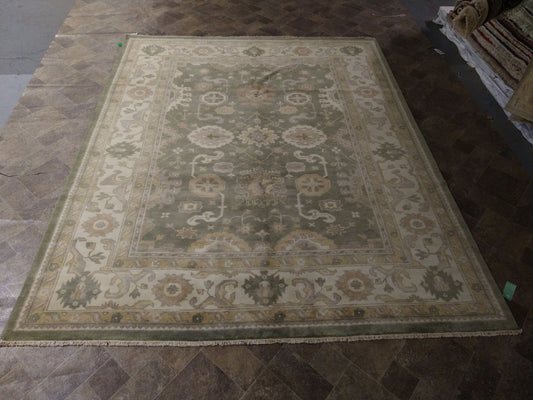
Persian vs Turkish Rugs: Key Differences & How to Choose
Persian rugs are hand-knotted rugs made in Iran; Turkish rugs are hand-knotted rugs made in Turkey (Anatolia). The core technical difference is the knot: Persian weavers traditionally use the asymmetrical Senneh knot, which packs tighter and allows flowing, curvilinear floral designs. Turkish weavers use the symmetrical Ghiordes knot, which is stronger and produces bold, geometric patterns with a thicker pile.
Put simply: the Persian knot builds intricacy. The Turkish knot builds strength. Neither is better. They serve different visions, and the right one depends on the room you're putting it in.
Persian Turkish Origin Iran (formerly Persia) Turkey (Anatolia) Knot Senneh asymmetrical, single Ghiordes symmetrical, double Knot density Higher (up to 1,000+ KPSI) Lower, but stronger Design Curvilinear, floral, pictorial Geometric, tribal, angular Materials Wool or silk pile on cotton Wool pile on wool foundation Colours Jewel tones deep reds, blues, ivory Earth tones terracotta, saffron, olive Feel Finer, softer, more formal Thicker, sturdier, more casual Price Generally higher More accessible entry point Best for Formal rooms, low traffic, statement pieces High traffic, family rooms, modern and boho interiors
This is one of the most-asked questions in the rug world, and most answers stop at "Persian is fancier." That's not wrong, but it isn't useful. This guide takes you through the knot itself, how to read the back of a rug, the design languages, the materials, the regions, the price logic, and finally a clear recommendation for your specific home.
Start With Geography, Not Style
Before anything technical, the definitions:
- Persian rug = a hand-knotted rug made in Iran. Persia officially became Iran in 1935, but the rugs kept the older name because the West had already fallen in love with it.
- Turkish rug = a hand-knotted rug made in Turkey, historically Anatolia, the vast plateau that has been a crossroads of civilisations from the Hittites through the Ottomans.
That's it. Origin is the definition, not design. This matters more than you'd think, because it's the source of the single biggest myth in the category, which we'll get to shortly.
The Knot: Where Every Other Difference Comes From
At a glance: the Persian knot allows more knots per inch and therefore finer detail and curves. The Turkish knot is more secure and produces a thicker, more durable pile.
Every visual difference between these two traditions traces back to a small structural decision made hundreds of thousands of times per rug.
The Persian Knot (Senneh / Asymmetrical)
The weaver loops the yarn fully around one warp thread, then passes it behind the adjacent warp, leaving one side of the knot open. Because the knot is asymmetrical and compact, it can be packed much more densely than its Turkish counterpart.
What that buys you:
- Higher knot density (KPSI). Fine Persian city rugs regularly hit 400 to 700 knots per square inch, and exceptional silk pieces from Qom exceed 1,000.
- Curves. More knots per inch means smaller "pixels," so a vine can bend like ink from a pen instead of staircasing into visible steps.
- A softer, finer hand. The pile sits shorter and denser.
The trade-off: individually, the knot is less secure than the Turkish one, which is why very fine Persian rugs prefer low-traffic rooms.
The Turkish Knot (Ghiordes / Symmetrical)
The weaver wraps the yarn around two adjacent warp threads and draws both ends up through the middle, so the knot grips symmetrically from both sides. It's sometimes called the double knot.
What that buys you:
- Structural strength. The double grip makes it exceptionally secure, which is why Turkish rugs are the traditional choice for rooms that actually get used.
- A thicker, plusher pile. More wool sits in each knot.
- Graphic clarity. The knot's shape resists tight packing, so designs lean geometric, and up close the pattern has an almost pixelated, deliberate look that reads as charm rather than compromise.
The trade-off: intricate floral curves are simply harder to draw at lower densities. So Turkish weavers didn't fight the loom, they built a whole visual language out of it.
And the Third One Nobody Advertises
There's a jufti knot, tied across four warps instead of two. It covers ground twice as fast and uses half the wool, and it produces a noticeably inferior rug: thinner, faster to wear, and blurry when it attempts detail. It shows up in lower-quality workshop output (some Kerman rugs, notably). Reputable dealers don't carry jufti rugs, and now you know one more thing to ask about.
How to Read the Knot From the Back of a Rug
This is the practical skill, and it takes about ten seconds once you know what you're looking at. Flip the rug and study the little nodes of colour on the back.
- Symmetrical (Turkish) knots produce a uniform, orderly, almost rectangular grid. The nodes line up in tidy rows and columns like graph paper.
- Asymmetrical (Persian) knots produce a staggered, diagonal, slightly less organised look. The nodes seem to lean or shift rather than sitting squarely.
Neither appearance means better or worse. It tells you which tradition the weaver worked in, and combined with the design and the wool, it's most of what you need to place a rug's origin.

The Biggest Myth in the Category
Here's the thing almost every article gets wrong, and it's worth putting plainly:
Persian rugs do not always use the Persian knot.
"Persian rug" describes where a rug was made, not how. Plenty of rugs woven in Iran use the Turkish symmetrical knot, most famously in Tabriz, and in the geometric weaving of Heriz in the northwest, where nomadic and Turkic populations settled centuries ago and brought their knot with them. Meanwhile, the Persian asymmetrical knot is used far beyond Iran, across Afghanistan, India, Pakistan and Central Asia.
So the knot tells you about a rug's weaving lineage, not its passport. Anyone who tells you a rug can't be Persian because it uses a Turkish knot has misunderstood the terms, and probably a few other things too.
Design: Curves vs Corners
The knot decided the design language, and centuries of tradition did the rest.
Persian design is curvilinear and dense. Flowing floral arabesques, layered medallion systems, vines that wander and rejoin, hunting scenes, pictorial panels, and the celebrated chahar bagh or "paradise garden" layout, a rug organised as a formal garden divided into quadrants, an entire cosmology woven into the floor. Persian design prizes balance, symmetry and detail so fine that you keep finding new things in it years later.
Turkish design is rectilinear and confident. Angular medallions, stepped diamonds, hooks, stars, stylised animals, and tribal motifs handed down through generations without a single drawing ever being written, encoded entirely in the weavers' hands. Turkish rugs also gave us the great tradition of the prayer rug, with its distinctive mihrab, an arch-shaped niche woven into the field to be pointed toward Mecca.
Stand back from a Turkish rug and it anchors a room with graphic force. Stand back from a Persian rug and it draws you in.
And yes, there are exceptions in both directions. Heriz is the classic "Turkish-looking Persian rug," all bold geometry. Turkish Oushaks, meanwhile, are famously soft, floral and large-scale, arguably more elegant than plenty of Persian village work. The traditions borrowed from each other for centuries; treat the rules as strong tendencies, not laws.

Materials: Wool-on-Wool vs Wool-on-Cotton
This is the difference nobody mentions and everybody feels underfoot.
Turkish rugs are traditionally wool-on-wool: wool pile knotted onto a wool foundation. The Anatolian plateau produces enormous quantities of excellent wool, and using it throughout gives the rug a warm, soft, slightly rustic hand.
Wool-on-wool rugs are naturally dirt- and moisture-resistant, they flex and drape rather than lying stiffly, and they develop a genuine patina as they age, the surface roughening and softening into something that tells its own story.
Persian rugs are typically wool or silk pile on a cotton foundation. Cotton is dimensionally stable, it doesn't stretch, and that stability is precisely what allows the fine, tight knotting Persian rugs are famous for. It's also why Persian rugs often have that faint silken sheen: dense pile on a taut foundation catches light.
At the top end, Persian workshops in Isfahan, Tabriz, Kashan and Qom work in silk, either as highlights that outline the design or as a full silk pile. Full-silk Persian rugs are extraordinary and extremely fragile, they belong on a wall or in a room nobody walks through.
Both traditions used the same natural dyes: madder root for reds, indigo for blues, pomegranate rind for yellows and greens, oak gall for blacks. Natural dyes don't fade harshly, they mellow, which is why a well-kept old rug of either origin often looks better at fifty than it did at five.
Colour: Jewels vs Earth
Persian palettes lean jewel-toned: deep madder reds, rich indigos, ivory fields, gold and rose accents. Each region has a signature, the cool blues of Tabriz, the warm brick reds of Heriz, the ivory grounds of Nain. The effect is formal, rich, and artistically composed.
Turkish palettes lean earthy: terracotta and rust from the clay soil, saffron and ochre, olive greens, soft Mediterranean blues, and creamy beiges straight from undyed wool. The effect is warm, grounded and approachable, and it's a large part of why Turkish rugs slot so easily into modern, Japandi, wabi-sabi and bohemian interiors that would reject a formal Persian medallion outright.
The Regions Worth Knowing
Persian (Iran)
- Tabriz: the master workshop city. Anything from fine medallions to pictorial rugs, often with the highest knot counts. Frequently uses the Turkish knot.
- Isfahan: refined, symmetrical, often silk-highlighted. Among the world's most valuable.
- Kashan: the classic ornate medallion on a red or navy field, the image most people picture when they hear "Persian rug."
- Qom (Qum): silk masterpieces, astonishing knot density, collector territory.
- Nain: ivory fields, blue accents, exceptionally fine.
- Bidjar: woven by Kurdish weavers, so tightly packed they're nicknamed the "iron rugs of Persia."
- Heriz: bold geometric medallions, coarse durable wool, the outlier that looks Turkish.
Turkish (Anatolia)
- Oushak (Uşak): large-scale, soft, floral, ivory and gold fields. The elegant face of Turkish weaving, and hugely influential, our own Chobi and Peshawar rugs descend directly from the Oushak and Ziegler tradition.
- Hereke: the imperial workshop. Fine silk rugs, made for the Ottoman court.
- Konya, Bergama, Milas: village and tribal weaving, bold geometry, prayer rugs, saturated colour.
- Cappadocia: earthy palettes and strong provenance stories.
- Kilim: Anatolia's great flatweave tradition, no pile at all, a different craft entirely. See our kilim guide.

Durability: The Honest Comparison
Here's where the marketing usually misleads people. Higher knot count is often sold as "better," and buyers assume that means tougher. It doesn't.
A higher KPSI means more detail, not more durability. The Turkish symmetrical knot is structurally the more secure of the two, and combined with a thicker wool pile on a wool foundation, Turkish rugs are genuinely the more robust everyday floor covering. They're built to be lived on.
Fine Persian city rugs, with their short, dense, delicate pile, are more precious, and they'd rather you didn't wear boots. That's not a flaw, it's a different job. A Qom silk rug isn't trying to survive your labrador. It's trying to be the best thing in the room.
And both traditions produce rugs that last centuries when treated properly. A well-made hand-knotted rug of either origin will outlive the person who buys it. The [cost-per-year maths](INTERNAL LINK: /blogs/rug-guides/are-hand-knotted-rugs-worth-it) works out beautifully either way.
Price and Value
| Factor | Effect on price |
|---|---|
| Knot density (KPSI) | Higher = more labour = higher price |
| Material | Silk ≫ fine wool > standard wool |
| Origin | Persian city workshops (Isfahan, Tabriz, Qom) command the highest prices globally |
| Age & condition | Well-preserved antiques often exceed new pieces |
| Size & rarity | Larger and rarer = higher |
Generally, Persian rugs cost more. Higher knot counts mean more months of labour, and Western collectors have been bidding up Persian city rugs for well over a century.
Turkish rugs are the more accessible entry point into genuine hand-knotted ownership, and that's a real advantage, not a consolation prize. You get authentic craft, superb wool and enormous character for meaningfully less money.
As an investment? Both can be. Persian workshop pieces dominate the top of the auction market, but rare antique Anatolian kilims, Hereke silks and early Oushaks are increasingly recognised as equally significant. For any buyer below collector level, authenticity, natural dyes, hand-knotting and honest provenance matter far more than which country the rug came from.

Which Should You Choose?
At a glance: buy Turkish for rooms you live in. Buy Persian for rooms you show.
Choose a Turkish Rug If…
- Your home is busy, kids, dogs, a hallway that never rests. The symmetrical knot and thick wool-on-wool build take it.
- Your interior is modern, minimalist, Japandi, wabi-sabi, bohemian or eclectic. Turkish geometry reads as contemporary graphic art.
- You want warm, earthy colour rather than formal jewel tones.
- You want authentic hand-knotted craft at a more accessible price.
- You like the idea of a rug that ages into character, developing patina rather than merely surviving.
Choose a Persian Rug If…
- The room is formal or low-traffic, a dining room, a study, a living room with a sense of occasion.
- You're drawn to detail: florals, medallions, curves, the kind of pattern you keep discovering things in.
- You want a statement piece with centuries of collector pedigree behind it.
- Your palette runs to rich reds, deep blues and ivory.
- You're buying something to hand down, and you want the version of that object with the deepest market.
Still Torn? A Shortcut
Ask what the room is for. A room you live in wants a Turkish rug. A room you present wants a Persian one. If a single rug has to do both jobs, a Heriz is the great compromise, Persian pedigree, Turkish-grade toughness, geometric enough for a modern room. Our Heriz guide covers it in full.

Before You Buy: The Checklist
✔ Flip it. Pattern legible in the knots on the back = hand-knotted. Uniform grid backing or glued canvas = machine-made or hand-tufted.
✔ Read the knot nodes. Tidy rectangular grid = symmetrical/Turkish. Staggered and diagonal = asymmetrical/Persian.
✔ Check the fringe. It should grow out of the warp, not be sewn on afterwards.
✔ Ask for the knot type, KPSI, fibre and origin in writing. Vagueness is an answer.
✔ Ask specifically about jufti knots on anything cheap that claims fineness.
✔ Look for abrash subtle colour bands from hand-dyed yarn batches. A good sign, not a defect. ✔ Match the rug to the room's traffic, not just its décor.
✔ Budget for a rug pad. Non-negotiable on hard floors.
Our full five-check authenticity guide walks through each of these in detail.

FAQs
What is the difference between Persian and Turkish rugs?
Persian rugs are hand-knotted in Iran and typically use the asymmetrical Senneh knot, allowing higher knot density and flowing floral designs. Turkish rugs are hand-knotted in Turkey using the symmetrical Ghiordes knot, which is stronger and produces bold, geometric patterns with a thicker pile.
Which is better, a Persian or Turkish rug?
Neither is objectively better. Persian rugs offer finer detail and greater formality; Turkish rugs offer superior structural durability and a more casual, graphic character. Choose Turkish for busy, modern homes and Persian for formal or low-traffic rooms.
What is the difference between the Persian knot and the Turkish knot?
The Persian (Senneh) knot wraps one warp thread and passes behind the next, leaving one side open, which lets weavers pack knots densely for curved, detailed designs. The Turkish (Ghiordes) knot wraps two adjacent warps symmetrically, creating a stronger, thicker, more geometric pile.
Do all Persian rugs use the Persian knot?
No. "Persian rug" means made in Iran, regardless of knot. Tabriz and Heriz rugs frequently use the Turkish symmetrical knot, and the Persian knot is used well beyond Iran, in Afghanistan, India and Pakistan.
Are Turkish rugs cheaper than Persian rugs?
Generally, yes. Turkish rugs typically have lower knot counts, meaning less labour per rug, and Persian city rugs carry over a century of Western collector demand. Turkish rugs are the more accessible entry into authentic hand-knotted ownership.
Which rug is more durable?
Turkish rugs, usually. The symmetrical knot is structurally more secure and the wool-on-wool construction is thicker. Higher Persian knot counts mean more detail, not more toughness, a common and expensive misunderstanding.
Can you tell a rug's origin from the back?
Largely, yes. Symmetrical (Turkish) knots form a tidy, rectangular grid of nodes on the back. Asymmetrical (Persian) knots look staggered and diagonal. Combine that with the design language and wool type for a confident read.
Summary
Persian rugs are woven in Iran with the asymmetrical Senneh knot, giving them higher knot density, flowing curvilinear designs and a finer, more formal character. Turkish rugs are woven in Anatolia with the symmetrical Ghiordes knot, giving them superior strength, a thicker wool-on-wool pile and bold geometric designs.
Persian for the room you present. Turkish for the room you live in. And if you want both at once, a Heriz.
Whichever way you lean, the things that actually determine whether you've bought well are the same in both traditions: genuine hand-knotting, honest wool, natural dyes, stated origin, and a size that fits the room.
Browse our hand-knotted collection knot type, fibre and origin stated on every piece, with a certificate of authenticity.