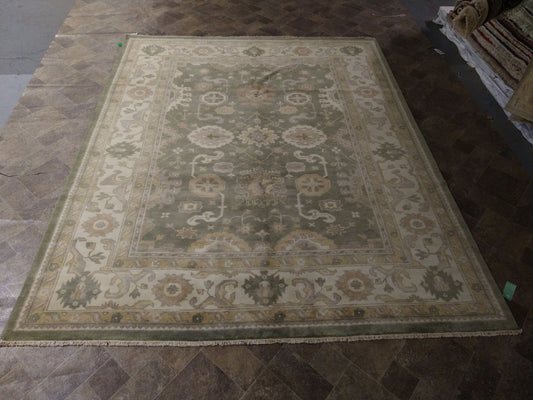
What Size Rug for a Queen Bed? 8x10 vs the Rest
If you've ever stood in your bedroom holding a tape measure and wondering whether you can get away with the smaller rug, this is the answer: for a queen bed, an 8x10 is the size to buy in almost every case. It gives you around 24 inches of rug on each side and past the foot of the bed, which is exactly the balance designers work to, and it fits the vast majority of American bedrooms without crowding the walls.
A 6x9 works if the room is genuinely small or the budget is tight. A 9x12 is the upgrade if your bedroom is large or you want the full luxury coverage. And a 5x8 has one specific job, which we'll get to at the end. Here's the whole picture.
Start With the Bed Itself

A standard queen mattress is 60 inches wide by 80 inches long (5 feet by 6 feet 8 inches). Your bed frame is usually a couple of inches wider on each side than the mattress, so measure the frame if you have one, not the sheets.
Then the golden rule the entire industry works to: the rug should extend 18 to 24 inches beyond the bed on the sides and at the foot. Eighteen inches is roughly the distance your feet travel when you swing out of bed, so that overhang is the soft landing you're actually paying for. Below 12 inches, the rug reads as an afterthought. Above 24, you're buying more rug than the room needs.
Do the maths on a queen bed: 60 inches + 24 inches per side = 108 inches, which is 9 feet. That's precisely why an 8x10 (turned so the 10-foot side runs across the bed's width) is the standard answer: it gives you close to that 24-inch overhang without needing a bigger, pricier rug.
8x10: The Answer for Most Queen Bedrooms
An 8x10 is the interior designer's default for a queen bed, and once you understand the maths above, you can see why. Turned so the 10-foot dimension runs across the bed's width, an 8x10 leaves roughly 24 inches of rug on each side and at the foot, exactly the target for a balanced, hotel-suite look. It works in a full-coverage layout (bed, nightstands and all on the rug) or in the more common partial-coverage layout, which we'll come back to.
An 8x10 also happens to be one of the most versatile sizes to own. If you ever move the rug to a living room, it's the default there too, and if you upgrade to a king bed later, an 8x10 works in a partial layout under a king. It's rarely a wasted purchase.
Best for: most primary and guest bedrooms, roughly 11x13 up to 13x14 feet.
6x9: When the Room Is Small or the Budget Is Tight
A 6x9 is the sensible smaller option for a queen bed, and it works, provided you understand what you're buying. With the 9-foot dimension across the bed's width, a 6x9 gives you around 18 inches of rug on each side, right at the low end of the acceptable range. It's snug rather than generous, and the nightstands stay off.
It's the right call in a genuinely small bedroom where an 8x10 would run close to the walls, or if the budget won't stretch to the bigger size. Just know the margins are thin, and if you're wavering between the two, go bigger.
Best for: rooms around 10x12 feet, guest rooms, tighter budgets.
9x12: For Large Bedrooms or Full Coverage
If your bedroom is spacious enough, or you want the bed, both nightstands and a bench at the foot all to sit on the rug in a full-coverage layout, step up to a 9x12. You get generous 30-inch reveals on the sides and enough length to run from behind the nightstands all the way past the foot of the bed.
This is the upgrade for a large primary suite, not a compulsory purchase, an 8x10 handles most queen bedrooms perfectly. But if you have the room and the budget, a 9x12 is what a hotel-style suite calls for.
Best for: primary bedrooms 14x16 feet and up.
5x8: The One Very Specific Job
A 5x8 under a queen bed is almost always too small if you're trying to place it lengthwise. But it has one job it does beautifully: laid horizontally across the foot of the bed, touching nothing else. That gives you a soft landing zone in front of a bench or reading chair and adds pattern and colour to the room, at a fraction of the cost of a room-size rug.
In a small bedroom where an 8x10 or even a 6x9 would swallow the floor, this at-the-foot placement is often the better-looking option. Don't dismiss it, it's a design choice, not a compromise.
How to Place the Rug Under a Queen Bed
Size is only half the decision. Where you slide the rug matters as much, and this is where most bedrooms go quietly wrong.
The most common layout, and the one that suits an 8x10 or 6x9, is partial coverage. The rug starts partway down the bed, usually just below the nightstands, so the lower two-thirds of the bed sits on it. Your feet land on wool getting out of bed, and the headboard end sits on bare floor. Clean, budget-friendly, and it works in almost any room.
Full coverage puts the bed, both nightstands and any bench at the foot on the rug, needs a 9x12 minimum, and looks the most polished, calm, symmetrical, hotel-like. Worth doing if the room is big enough.
Two runners on either side of the bed is the honest alternative if a large rug is out of budget, or if the floor is beautiful and you don't want to hide it. Your feet land on wool where they actually touch down, and nowhere else. Hotels use this arrangement all the time.
One placement rule that trips people up: nightstands are either fully on the rug or fully off, never half. Front legs on and back legs off looks unbalanced every single time, whichever room and whichever rug.
Whichever layout you pick, aim for that 18 to 24 inches of visible rug on each side of the bed, and keep 8 to 12 inches of bare floor between the rug and the walls. Our rug placement guide has the full breakdown.

The Mistakes to Avoid
The single biggest mistake with a queen bed is the same as with every bed: buying too small because it's cheaper at checkout. The 6x9 costs less than the 8x10 and quietly promises it'll probably be fine. Sometimes it is. More often, you notice the pinched margins every morning and wish you'd sized up. When in doubt, go bigger.
Other common ones:
- Placing the rug wrong way round. The longer dimension should run across the width of the bed, not along its length. This one takes people by surprise, but the rug is meant to give you a landing on both sides, not stretch away toward the wall.
- Ignoring the room. An 8x10 in a bedroom that can only handle a 6x9 will run within inches of the walls and look like fitted carpet that came up short. Measure the room, not just the bed. Our rug size guide covers the wall-to-rug spacing.
- Skipping the pad. A big rug on a hard floor slides. A pad stops the sliding, cushions the pile, and extends the rug's life.
- Not taping it out. Four dollars of painter's tape, applied to the floor in the exact rug dimensions, prevents almost every mistake above. Walk around it, sit on the edge of the bed, open the closet. Then buy.
What About Style?
A quick note on choosing the rug itself, because a bedroom is one of the best rooms in the house to buy well.
Bedrooms are low-traffic, which means you can go for softer, finer, more beautiful rugs here than anywhere else, they won't get the abuse that a hallway or a living room delivers. A hand-knotted wool rug in a bedroom stays looking new for decades, and the quiet rows of a Bokhara, the washed palette of a Chobi, or the classic curves of a Kashan all suit a room built for sleeping.

The Bottom Line
For most queen bedrooms, buy an 8x10, place it under the lower two-thirds of the bed with roughly 24 inches of rug visible on each side, and use a pad. Go smaller only if the room truly demands it, and size up to a 9x12 if you want the full-coverage look with nightstands on. And if you're between two sizes, always take the bigger one, a slightly-too-big rug looks intentional, a slightly-too-small one just looks small.
Browse our hand-knotted wool collection sized for every bedroom.