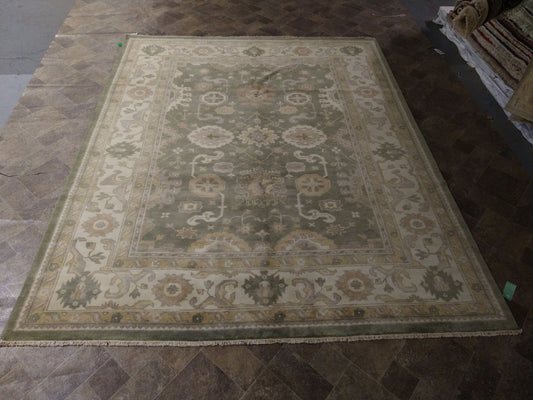
What Do Rug Symbols Mean? Motifs in Persian Rugs
Here's something that takes most rug owners years to notice: every motif in a hand-knotted rug means something. Not vaguely, not stylistically, specifically. The little teardrop was once a Zoroastrian flame.
The scrolling vine represents eternal life. The pomegranate carries fertility. The eye at the corner is watching for you. Weavers weren't decorating floors, they were writing.
Once you know what the symbols mean, a rug stops being an object and becomes a message someone left for you a hundred years ago. Here are the ones you're most likely to see, and what they were saying.
First, a Small Caveat
The meanings you're about to read are the traditional ones, the ones passed down through weaving families and recorded by scholars. In practice, some symbols have travelled far from their origins and picked up new meanings along the way (the boteh became "paisley" in Scotland and lost its fire in transit), and some tribal weavers used motifs simply because their mothers did.
So take these meanings as the honest historical layer, not a rigid code. What matters is that the symbols had meaning, and much of that meaning is still visibly at work in the rugs.
The Tree of Life
If you learn only one motif, learn this one. The tree of life is arguably the most recognisable image in Persian and Oriental rugs, a stylised tree, often a cypress or willow, sometimes rooted in a vase, its branches spreading toward the top of the field.
It represents the link between earth and sky, the mortal and the divine, and in some traditions the passage from this life to the next. You'll see it most often in prayer rugs, rising from the base of the mihrab and reaching toward heaven, but it appears everywhere: Baluch rugs, Bakhtiari carpets, tribal weavings from across the region.
When a rug shows a tree of life, it isn't decoration. It's a diagram of a worldview.
The Boteh (aka Paisley)
The little curved teardrop, sometimes small and repeated across the whole field, sometimes drawn large as a design centrepiece. The boteh is one of the oldest motifs in Persian art, and its meaning has more theories than most rugs have knots.
The most-cited interpretations: a flame (linking it to ancient Zoroastrian fire worship), a cypress tree bent by the wind (a symbol of humility before God), and a pear or almond (fertility and abundance). Whichever origin you prefer, the boteh has always carried life-force, the flame that keeps burning, the tree that keeps bowing, the seed that keeps producing.
The West adopted it as paisley when the shawls came through Kashmir and the pattern was copied by mills in Paisley, Scotland. It got a new name but kept the shape. What it lost was the meaning.
Most common in Hamadan, Qom and city rugs, but you'll see it almost everywhere once you know to look.
The Medallion
The most important motif in a formal Persian rug, and the one that says the most about what a rug is for. A central medallion, an ornate shape floating in the centre of the field, has been read for centuries as a symbol of the dome of heaven, or of the sun, and by extension the divine order that holds the design together.
Classical Persian rugs are laid out around a medallion the way a mosque is laid out around a dome: the medallion at the centre, four quarter-medallions at the corners echoing it, and everything else, vines, blossoms, borders, arranged in radiating balance. It's a small cosmos woven into wool.
This is why Kashan and Tabriz rugs feel formal in a way village rugs don't, they're architectural. The medallion is the building.
The Evil Eye (Nazar)
Look at the corners and edges of many tribal rugs and you'll see small triangles, diamonds, or eye-like shapes with a dot in the middle. These are protective evil-eye motifs, meant to catch and deflect the malicious gaze of jealousy and ill-will.
The Middle East and Central Asia take the evil eye seriously as folklore, and weavers protected the household by weaving eyes into the rug itself. Sometimes they appear as amulets in the borders, sometimes as hidden hooks and diamonds scattered through the field. Once you notice them, you find them everywhere in Kazak and Turkmen weaving.
The rug isn't just decorating your floor. It's watching.

The Pomegranate
A round fruit heavy with seeds, often shown split open. The pomegranate is one of the great fertility symbols of Persian art, and by extension a symbol of prosperity, abundance and immortality (the fruit was thought never to spoil). Weavers put pomegranates into wedding rugs and dowry rugs specifically, weaving hope for children and a full household into the pattern.
Also appears frequently in city rugs as a design flourish, and in tribal weavings as part of a "garden" composition.
Vines, Flowers and the Garden
The dense floral fields you see in city rugs, Kashan, Tabriz, Sarouk, aren't random. They're paradise gardens.
In the Persian tradition, paradise (paradaisos) is literally an enclosed garden, and one of the most enduring rug designs is the chahar bagh or "four garden" layout: a rug organised as a formal garden divided by canals into four quadrants, with flowers, birds and sometimes fish woven into each. A Persian rug is often, quite literally, a garden you can walk on. Every rose, tulip, lotus and vine in it carries a specific meaning in the tradition, love, purity, spirituality, renewal.
Vines and scrolls are eternity, the endless line. Flowers are life. Cypress trees are eternity again (evergreen) and grief (they don't bend). Once you learn to read them, a Persian floral rug becomes something closer to a poem than a pattern.
Tribal Motifs: The Language of Village Rugs
Tribal and village weavers had a smaller vocabulary and used it more freely, and their symbols are some of the most touching in the whole tradition, because they were personal.
- Comb hygiene and purity. Often woven into rugs for brides.
- Ram's horn strength, virility, masculine power.
- Hand (Hamsa) protection against harm.
- Scorpion protection from the venomous version of itself, apotropaic magic.
- Camel, dog, rooster, peacock each with its own layer of meaning across regions.
- Willow leaves and small "S" hooks life force and protection, favourites of Baluch weavers.
You see these most in tribal rugs from the Caucasus, Turkmen weavings, and Baluch rries and hopes of the specific person at the loom.
The Mihrab (Prayer Arch)
If a rug has a pointed arch at one end, that's a mihrab, and the rug is a prayer rug. The mihrab represents the niche in a mosque wall that points toward Mecca, and the weaver points it that way when the rug is laid down for prayer. Often you'll see a lamp hanging within the arch (a reference to the ayat al-nur, the "verse of light" from the Quran), or a tree of life rising inside it.
Prayer rugs are their own genre, small, portable, deeply personal, and they show up frequently in Baluch and Anatolian Turkish work. Even if you don't pray, understanding the mihrab tells you what the object was made for.
Guls: The Rose That Isn't a Rose
The word gul is Persian for flower or rose, but in the rug world it specifically means the repeating octagonal or diamond-shaped medallions that fill the field of Turkmen weavings, Bokhara rugs above all. Each Turkmen tribe had its own signature gul, the Tekke, the Salor, the Yomud, the Ersari, and the gul was essentially a tribal emblem, a woven family crest repeated across the rug the way a coat of arms would be.
So a Bokhara isn't a floral rug. It's a rug covered in rows of tiny family flags.

How to Read a Rug in Two Minutes
Once you have the vocabulary, running a quick scan is genuinely fun.
Look at the field. Is there a central medallion (city rug, formal, "dome of heaven"), a repeating pattern (allover florals = garden; guls = tribal emblems), or a pointed arch (prayer rug)?
Look at the border. Small repeating hooks, diamonds and eye-shapes usually carry protective meaning. Vines and scrolling flowers usually carry eternity or life.
Look for a tree. Rooted in a vase, rising up the field, this is a tree of life. Anywhere you find one, the rug is talking about the link between the mortal and the divine.
Look at the corners. Quarter-medallions in the corners echo the central one, cosmic order, symmetry. Small hooks or diamonds tucked into the corners are usually protective.
Look for what repeats. Boteh, pomegranates, small combs, hands, animals, whatever repeats was on the weaver's mind. Often you can guess what the rug was for (dowry, prayer, everyday) from what dominates.
Two minutes, and the rug has told you its story. Try it on your own rug tonight.

Why This Matters When You're Buying
Two practical reasons.
First, once you can read symbolic vocabulary, you can choose a rug that means something to you. A tree of life in the entry (welcome, threshold), a pomegranate in a bedroom (fertility, abundance), a garden in the dining room (paradise, gathering). It turns a purchase into a curation.
Second, symbolism is one of the quiet markers of authenticity. Machine-made "kilim-style" and "Persian design" rugs copy the shapes without understanding what they mean, so the motifs are often placed randomly or drawn wrong (a tree of life growing sideways; guls that don't match any known tribe; borders with meaningless invented shapes). A hand-knotted rug from a genuine tradition uses the vocabulary correctly, because the weaver was taught it. Learning to read the symbols is another way of learning to read the rug's honesty.

The Bottom Line
A hand-knotted rug is one of the last everyday objects still made in a symbolic language. Every real one you'll ever own carries a small message, some more legible than others, and once you learn the vocabulary you carry that reading with you for the rest of your life. Look at the rug under your feet. Somewhere in it is a tree, or a flame, or an eye. Someone put it there for a reason.
Browse our hand-knotted collection every rug woven in a real tradition, every symbol placed with meaning.