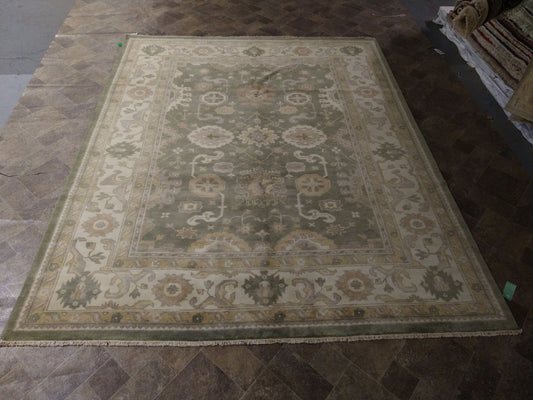
Sarouk Rugs: The American Classic Persian, Explained
There's a good chance you've stood on one. For most of the twentieth century, the Sarouk was the Persian rug in American homes, the deep red one under the dining table at your grandmother's house, the one nobody ever managed to wear out. It sold in numbers no other Persian style came close to.
And it has the strangest backstory in the entire rug world. Because a great many of those rugs arrived in New York, got chemically stripped of their original colour, and were then repainted by hand, with brushes, to suit American taste. That is not a rumour. It's an industry that ran for decades.
Here's the whole story, and how to tell what you're actually looking at.
Where Sarouks Come From
Sarouks are woven in and around the village of Saruk, roughly thirty miles north of the city of Arak in Iran's Markazi Province, central-western Iran. Arak was historically called Sultanabad, a name that still carries weight in the rug trade, and understanding it explains everything that follows.
In the late nineteenth century, Persian weaving had declined badly. Then the great carpet exhibitions in Vienna and London lit a fire under Western demand, and merchants scrambled to organise supply.
Western firms set up shop in Sultanabad, the British-Swiss company Ziegler & Co. opened there in 1883, followed by American outfits like the Eastern Rug Trading Company. They didn't just buy rugs. They commissioned them, to specifications, for foreign living rooms.
So the Sarouk was, almost from the beginning, a Persian rug woven with a Western customer in mind. That's not a knock on it. It's the reason it exists in the numbers it does, and the reason your grandmother had one.
How to Recognise a Sarouk
Look for what's missing. Most classic Persian city rugs organise themselves around a central medallion. The classic Kashan medallion is the textbook example.
The American Sarouk usually has no medallion at all, or only a small floral suggestion of one. Instead, the field carries detached floral sprays, little bouquets scattered across an open ground like blossoms strewn on a floor.
Then look at the colour. Deep raspberry red, burgundy, rose or salmon fields, almost always, with a dark navy border. Red is so central to the Sarouk identity that collectors call it the classic red rug.
Then pick it up. Or try to. Sarouks are double-wefted on a stiff cotton foundation with a heavy, densely packed wool pile, and a full-pile room-size Sarouk is genuinely heavy. That density is not decorative. It's why these rugs are still here.
The knotting is usually the asymmetrical Persian (Senneh) knot, though some Sarouks use the symmetrical Turkish one, a useful reminder that the knot doesn't determine a rug's origin. Good Sarouks often run past 200 knots per square inch, more than enough for the curvilinear floral drawing the style depends on.

The Painted Sarouk: The Strangest Story in Rugs
Now the good part.
From roughly the 1910s through the 1950s, with peak production between 1920 and 1940, Persian workshops wove Sarouks specifically for the American market. Americans loved the curvilinear floral designs. What they did not love was the colour.
The traditional Sarouk field was often a soft salmon-pink shade the weavers called doghi, produced by combining madder dye with yogurt or whey, a technique peculiar to the region. It's a beautiful colour. It was also, to 1920s American taste, entirely wrong. Buyers wanted deep, saturated, uniform reds.
So importers solved it at the dock. Rugs arriving in New York were chemically washed to strip out the original colour, then hand-painted with synthetic dye, using brushes, to a deep raspberry or burgundy.
One New York firm, Rug Renovating, built a business on it and is still operating. Thousands upon thousands of rugs went through this process. Greens, blues and yellows were often altered too.
The weaving stayed Persian. Only the surface was rewritten. And the result, the American Sarouk, or Painted Sarouk, became one of the most popular Oriental rugs ever sold in the United States.
How to Spot a Painted Sarouk
It's easier than you'd think, and it's the single most satisfying test in rug-buying.
Part the pile. Push the wool apart with your fingers and look down at the base of the knots, where the brush couldn't reach. On a painted Sarouk, the surface is deep red and the base is noticeably lighter, often that original rose or salmon. The rug is two colours, stacked.
Compare front and back. Same principle. A light rose ground on the back and a dark, saturated red on the face is close to conclusive.
Look for the brushwork. After a century, the paint has aged. You'll often see faintly uneven strokes, darker patches where dye pooled, and mottled areas where the treatment mellowed at different rates. It reads as patina now, not as damage.
Check the colour's behaviour. Painted fields tend to look too uniform, flatter and more consistent than naturally aged dyes, which mellow unevenly and show abrash and other hallmarks of hand-dyed wool.
And here's the important part: a painted Sarouk is not a fake. It's a genuine hand-knotted Persian rug with a documented commercial history. The weaving is real, the wool is real, the age is real.
The overdye is part of the object's story, and the market treats it that way, painted Sarouks remain highly collectible. Any dealer who hides the painting is being dishonest. Any buyer who thinks it disqualifies the rug has misunderstood what they're holding.

The Sarouk Family: Not All of Them Are Painted
"Sarouk" covers several distinct traditions, and the differences matter for both price and looks.
Farahan (Feraghan) Sarouk. The nineteenth-century antecedent, and to many collectors the most refined. Older, earthier central-Persian palette, terracotta, madder, rust, indigo, soft green, camel, ivory.
Usually medallion layouts with Herati-derived patterns and delicate vine work, more architectural and restrained than anything that came later. Genuine antique Farahans are rare and highly collectible.
Mohajeran Sarouk. Early twentieth century, and often considered the finest expression of the whole tradition. Airier drawing, more focus on blossoms and trees, and a signature willow tree motif that's almost a fingerprint. Finer knotting, softer palette.
American Sarouk. The famous one. Detached floral sprays on red, rose or salmon fields, thick pile, bold drawing, big room sizes, and often, though not always, painted.
Josan and Lilihan round out the Arak-region family, related weavings from neighbouring villages with their own quirks.
If you're buying, know which one you're looking at, because the price gap between a fine antique Mohajeran and a 1940s American Sarouk is substantial. The American ones are the accessible entry point, and there are far more of them.

Why They Refuse to Die
Sarouks have a reputation, earned across a century of American floors, for simply not wearing out. Three reasons.
The wool. Arak-region wool is high quality, soft but resilient, and it takes dye with a velvety lustre that gives good Sarouks their subtle sheen.
The construction. Double-wefted, stiff cotton foundation, densely packed knots. These rugs are built like furniture, not textiles.
The pile. Thick and heavy, so there's simply a great deal of wool between your feet and the foundation. That's the whole secret of rug longevity, and it's why the [highest knot count isn't always the toughest rug highest knot count isn't always the toughest rug.
Full-pile antique Sarouks turn up regularly at estate sales having survived four generations of a family, and they're still going. That's not marketing. That's just what these rugs do.

Where a Sarouk Belongs
The Sarouk was made for the American formal room and it still owns that job: dining rooms, traditional living rooms, studies, entry halls. The deep red and navy palette flatters dark wood, brass, leather and books, and the dense pile handles the traffic those rooms actually get, which a finer city rug wouldn't enjoy nearly as much.
Because most American Sarouks have an open field with no dominant medallion, they're also easier to live with in modern rooms than you'd expect, there's no central focal point demanding a symmetrical furniture arrangement around it. Put one under a contemporary sofa and the scattered florals read as texture rather than formality.
They came in room sizes for a reason, most are 8x10, 9x12 and larger, so check your measurements against the rug size guide before you fall in love with a specific piece.
And if the red is what draws you, our guide to choosing a rug colour covers what deep red actually does to a room.
Caring for One
Standard hand-knotted wool care: vacuum weekly without the beater bar and keep the fringes out of the machine, rotate twice a year, use a rug pad, blot spills immediately with cool water, and keep it out of prolonged direct sun, painted fields in particular can shift unevenly with heavy UV exposure.
Moths adore full-pile Sarouks, so inspect an older one annually, and if you ever store it, roll it, never fold it. The full routine is in our rug cleaning guide.
FAQ
What is a Sarouk rug?
A hand-knotted Persian rug from the village of Saruk near Arak, in Iran's Markazi Province. Sarouks are known for curvilinear floral designs, deep red fields, dense wool pile and heavy double-wefted construction.
What is a Painted Sarouk?
An American Sarouk whose original colour was chemically stripped after arriving in the US, then hand-painted with synthetic dye to the deep raspberry or burgundy Americans preferred. It was standard practice from the 1910s to the 1950s, and painted Sarouks are genuine hand-knotted Persian rugs, not fakes.
How do I know if my Sarouk is painted?
Part the pile and look at the base of the knots. If the wool is a lighter rose or salmon underneath while the surface is deep red, it was painted. Comparing the front and back of the rug shows the same thing.
Are Sarouk rugs valuable?
Yes, though the range is wide. Antique Farahan and Mohajeran Sarouks are the collector's tier. American Sarouks are more widely available and more affordable, while still being genuine, durable antique Persian rugs.
Are Sarouk rugs durable?
Exceptionally. Dense Arak wool, a stiff double-wefted cotton foundation and a thick pile make Sarouks among the toughest Persian rugs ever woven. Century-old examples are still in daily use.
Bottom Line
The Sarouk is the Persian rug that met America halfway, woven in Iran, finished for New York, and durable enough that a hundred years of American dinner parties couldn't dent it. Learn to part the pile and you'll read its whole biography in ten seconds.
Browse our Sarouk collection, or see how it compares to the rest of the tradition in our guide to Persian and Oriental rug styles.